3 Filters to Find Real "Unusual Options Activity” as a Beginner in 2026
Not all unusual options activity you see is a buy signal. Learn the 3 essential filters for beginners, including Volume vs. Open Interest, Sweeps, and Time Decay so you can distinguish real institutional bets from hedging noise.
Every day, institutions trade billions of dollars in options. In an attempt to profit from these whales, retail traders frequently examine "Unusual Options Activity" (UOA) scanners.
The harsh reality is that the majority of "unusual" activity is merely insurance.
A large order for put options may not indicate that a hedge fund believes the stock is collapsing. They may simply be protecting a sizable long stock position. You are betting on a crash while they are betting on a rally if you follow that trade without question.
You must sift through the noise in order to identify the real directional bets, those where institutions are aggressively positioning for a move.
These are the three crucial criteria for determining "Smart Money" conviction.
Filter 1: Volume > Open Interest
Question: How can you tell if a whale is closing an existing position or creating a new one?
The relationship between Volume (contracts traded today) and Open Interest (contracts held overnight) is the most crucial metric for examining options flow.
The rule is that you should see Volume > Open Interest (OI).
Why it is important:
- The trade might just be a whale closing out a position they had held for weeks if Volume < OI. This indicates that the move may be coming to an end, not that you should enter.
- It is mathematically impossible for all those trades to be closing positions if Volume > OI. There must have been new contracts. This suggests that "new money" and new positioning are joining in.
Filter 2: Sweeps vs. Splits
Question: Is the organization in a hurry or is it attempting to hide itself?
Institutions have two ways to buy options: slowly and carefully, or fast and aggressively. You want to follow the ones who are in a rush.
The "Sweep"
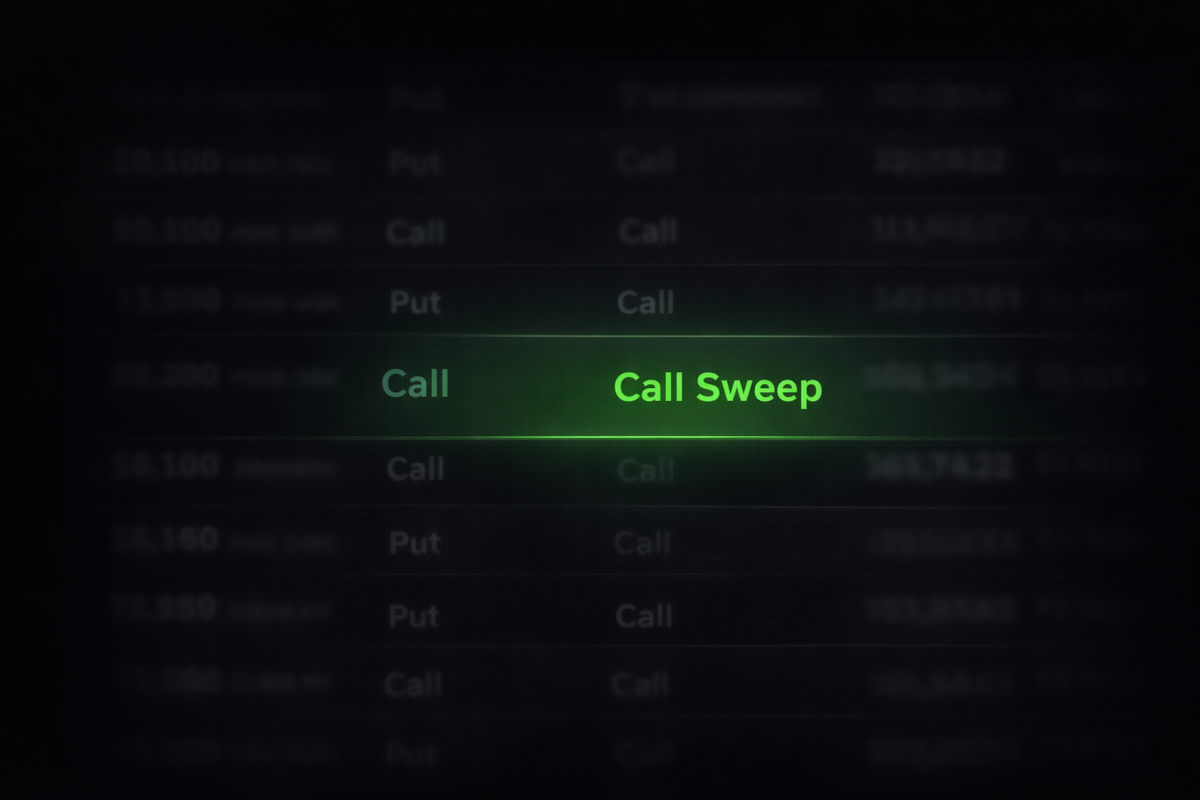
When a buyer wishes to fill a large order immediately, regardless of price, this is known as a Sweep. Their algorithm "sweeps" all accessible exchanges (CBOE, NYSE, ISE, etc.) to obtain every contract at the Ask price rather than engaging in negotiations.
What it indicates:
"I don't care if I pay a little extra; I need to get in NOW." This suggests they have strong convictions or time-sensitive information.
The "Split" (or Block)
In order to prevent price movement, a Split or Block trade is frequently negotiated in private off-exchange or worked slowly.
What it indicates:
Less urgency. Instead of being aggressive directional bets, these are frequently hedges or long-term portfolio adjustments.
The Filter:
Pay attention to Sweeps that are executed at or above the Ask price.
Filter 3: OTM & Short Expiry
Question: Ask yourself whether this a conservative hedge or a greedy bet?
The contracts a trader purchases can reveal a lot about their intentions. Generally speaking, institutional hedging appears conservative. Institutional speculation appears to be avaricious.
Steer clear of "Deep ITM" (In The Money):
When a whale purchases Deep ITM calls, they typically do so as a "stock replacement" strategy, which requires less capital than purchasing shares, as opposed to placing a wager on a huge explosion.
Target "OTM" (Out of The Money):
Purchasing OTM calls or puts with a short expiration period (two to four weeks) is a common sign of genuine conviction.
Why?
OTM options have only extrinsic value. These options expire at zero if the stock doesn't move quickly. By purchasing $1 million worth of OTM weekly calls, a whale is essentially saying, "I am 100% sure this stock is moving THIS week."
Comparison: Hedge vs. Real Bet
| Feature | The "Hedge" (Ignore) | The "Real Bet" (Follow) |
|---|---|---|
| Strike Price | At the Money / Deep ITM | Out of the Money (OTM) |
| Expiration | Long-term (LEAPS) or Quarterly | Short-term (Weekly/Monthly) |
| Strategy | Spreads (Buy one, Sell another) | Naked Calls/Puts (Single leg) |
| Price Action | Bought on the Bid | Bought on the Ask (Sweep) |
Frequently Asked Questions (FAQ)
Q: What is the best tool to find UOA?
A: Cheddar Flow, OptionStrat, and Unusual Whales are popular tools in 2025–2026. Trades on these platforms are automatically marked as "Sweeps" and filtered for "Vol > OI.”
Q: Can I trade UOA with a small account?
A: Yes, but exercise caution. "Smart Money" is resilient to a 50% drawdown and has substantial funds. You may be stopped out before the move occurs if you follow them with a small account.
Q: What does "Golden Sweep" mean?
A: When a trade is a Sweep, has a premium of more than $1 million, and is purchased OTM, the phrase "Golden Sweep" is frequently used. It's regarded as the "Gold Standard" for positive signals.