How is AI Enabling More Retail Participation in Algorithmic Trading?
For retail traders, AI is removing the barrier of coding. Learn how generative AI and no-code tools like quanteru are enabling regular investors to create, test, and implement expert trading algorithms.
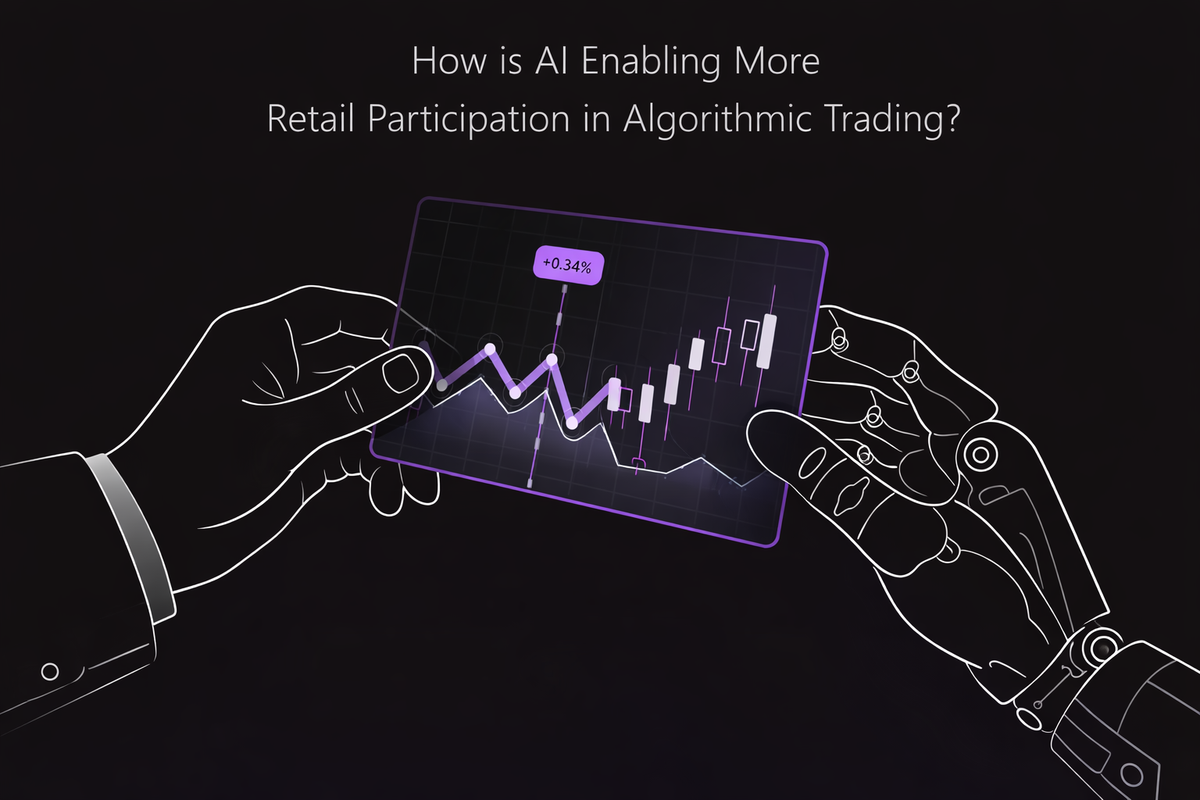
For decades, algorithmic trading has been like an exclusive club for institutional giants like JPMorgan and Citadel who possessed the high frequency infrastructure and PhD-level quants to run it.
But now that wall has crumbled.
As of early 2026, AI has turned what was once a "math problem" into a "prompt problem" due to which retail participation in the markets has surged, with recent data from JPMorgan indicating that retail trading accounted for 20–25% of total market activity in 2025.
How does AI remove the "Coding Barrier" for beginners?
The single biggest barrier to entry for retail investors has always been technical literacy.
And now what’s happening is that AI is allowing traders to write code using plain English, eliminating the need to learn languages like Python or C++.
Today, Generative AI and LLMs have democratized the process of building a trading bot, and traders no longer need programmers for small bots.
Platforms like Quanteru now enable users to type strategies like “Buy Bitcoin when the 50-day moving average crosses above the 200-day moving average," and the AI instantly transforms this into a deployable script for them to not only apply but also backtest and optimize.
Programs such as Composer and Pluto use AI backend logic to enable users to assemble "blocks" of logic (actions and triggers) without ever seeing a line of code.
AI copilots can now debug the code in real-time if a retail trader attempts to implement a flawed strategy, providing a clear explanation of the error and a solution.
What specific AI tools are retail traders using right now?
Retail investors are onboarding platforms that combine "Copilot" features with automated execution for their strategies.
The toolbox for the retail trader has expanded and based on market trends in late 2025 and early 2026, here’s what traders are flocking at:
- Generative Strategy Builders:
- These are used by traders to write the first boilerplate code for backtesting and to generate ideas for strategies.
- Automated Trading Bots:
- These platforms eliminate the need for the trader to be active as they are using AI to run "Grid Trading" or "DCA (Dollar Cost Averaging)" bots around-the-clock.
- AI-Powered Backtesting Engines:
- These tools examine more than 20 years of historical data to provide a trader with an accurate assessment of how their strategy would have performed. They frequently spot "overfitting" risks that a human might overlook.
Popular Example:
Traditional Retail vs. AI-Assisted Retail
| Feature | Traditional Retail Trading | AI-Assisted Algorithmic Trading |
|---|---|---|
| Execution Speed | Manual (Seconds/Minutes) | Automated (Milliseconds) |
| Trading Hours | Limited by sleep/work | 24/7 Operation |
| Decision Basis | Gut feeling / Technical Analysis | Data-driven / Probabilities |
| Emotion | High (Fear/FOMO) | Zero (Rules-based) |
| Barrier to Entry | Low (Open an account) | Medium (Requires strategy validation) |
What are the risks and limitations of AI in retail trading?
Despite the advantages, "Overfitting" and "Black Box" opacity are two new risks associated with AI trading. So knowing when this technology fails is crucial because AI is a tool that needs supervision; it is not a magical money printer.
- The Trap of Overfitting
Developing an AI model that performs flawlessly on historical data (backtesting) but fails in the real market is a common issue because instead of learning the patterns, the AI "memorizes" the past. - The Black Box Problem
Certain sophisticated AI tools are opaque as they base their buy/sell decisions on millions of factors that are hidden from the user which leads to the retail trader frequently not knowing “why” if the bot begins to lose money. - Flash Crash Vulnerability
Thousands of retail algorithms may simultaneously initiate a "sell" order during a dip, exacerbating market crashes, if they use similar AI models (e.g., all using the same ChatGPT prompt).
Frequently Asked Questions (FAQ)
Q: Do I need to know Python to do algorithmic trading?
A: Not at all. In 2026, "No-Code" platforms like Quanteru let you create strategies with visual blocks, and generative AI tools can write Python scripts for you.
Q: Is AI trading legal for retail investors?
A: Retail investors are permitted to engage in algorithmic trading. You are in charge of any trades your bot makes, though, and your broker must allow API access.
Q: Can AI guarantee profits in trading?
A: AI is not a guarantee; rather, it is a tool for execution and analysis. Even the best algorithms can lose money during black swan events because markets are unpredictable.
Q: How much money do I need to start?
A: Lot of stock platforms and AI cryptocurrency bots let you begin with as little as $100. However, a capital base of $1,000 or more is frequently advised for efficient risk management.