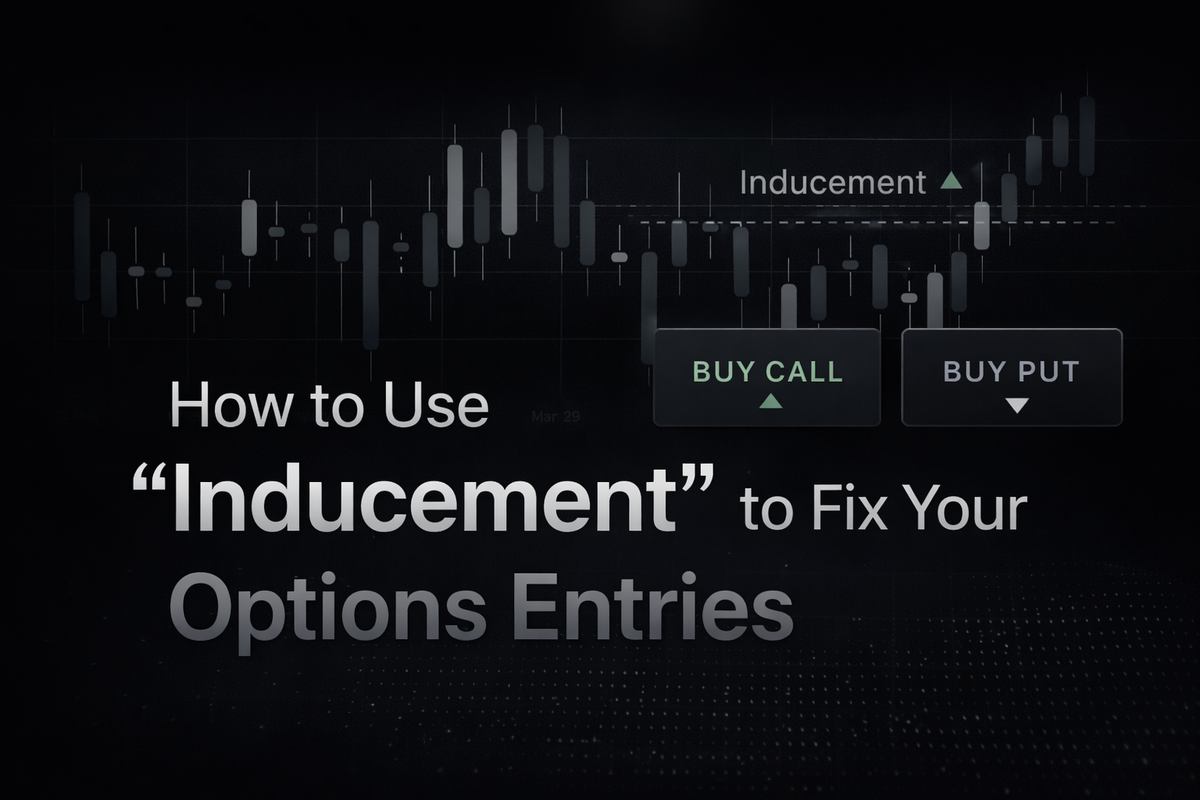
How to Use "Inducement" to Fix Your Options Entries
Ever had this happen?
You see a stock breaking out. It looks like your chance to shine so you buy a Call option. But the second you do it, immediately, the price reverses, hits your stop loss, and you lose the last few shillings you had.
You doubt your direction but then a few moments later it rips exactly where you thought it would go, just that you weren’t in the trade.
So it dawns that you didn’t get the direction wrong. You got caught in a Liquidity Trap or what professional traders call "Inducement".
In this piece I’m going to explain to you how to stop falling for it, and also rather how to use Inducement to make money. So first things first:
What is "Inducement"?
Think of the options market like a car and the orders (buyers and sellers) as the fuel for this car.
Now, Inducement is when the market baits the traders to enter earlier than they should’ve by painting a picture perfect scenario for entry.
There are 3 main components to inducement called
TRAP — BAIT — SNAP.
- The Trap is when the price moves to an obvious level, like the previous day’s high.
- The Bait usually is the when price action breaks that level just a tiny bit making everyone think "Breakout!" and buy Calls.
- The Snap happens a few moments after it when the big money pushes price back down to hit all those stop losses of retail traders. This snap creates the liquidity (which is the fuel) needed to move the price for real.
Why This Destroys Options Traders
If you trade normal stocks, a bad entry is annoying.
If you trade options, a bad entry is deadly.
Why?
Time Decay (Theta)!
You see what happens with options trader is that if you get stuck in a trap for even 30 minutes, your option contract starts to lose value with every passing second. Even if the price ends up going the way you hoped it will your contract might already be dead because of the time decay and volatility crush.
In late 2025, over 57% of SPX volume was 0DTE .
So this signified that the market moves fast and traps happen more often than you think.
So now how do you fix this?
The Simplest fix to Inducement is Waiting for the "Sweep"
Stop trying to predict the breakout like your YouTube guru.
Instead, let the trap spring before you enter. You can use this 3 step checklist to make sure the next time market is collecting fuel, you’re not baited.
- Spot the Trap
You do this by looking for obvious highs or lows (like the Pre-Market High or Yesterday’s Low). - Wait for the Sweep
Watch price break that level but don’t be a victim of FOMO and enter. - The Reclaim
Wait for the price to come back into the old range and this time make your entry.
For example, let’s say the market breaks a High. You should now wait for it to fail and drop back below that High. Once it does, that is your entry to sell your Calls or buy your Puts. You are now trading with the smart money, not the trapped money!
FAQs
- What if the sweep never happens?
Don’t guess, and don’t trade. Because missing a trade is better than losing a trade. - How do I protect myself if the market gets choppy?
Use Spreads!
Since timing is hard, you may consider using "Debit Spreads" where you buy one option and sell another. - When does inducement happens most often?
Near the Market Open and big news drops, so watch the clock.
In Short
Trading options is hard enough already, there’s no need to make it harder by taking the first bait you see. Give the market a chance to "induce" the impatient traders first and once the dust has time to settle, you may make your move.
Since this may be a new concept for you, I’d recommend that you open your chart right now and mark the High and Low of yesterday.
And then tomorrow, watch what happens when price touches those lines.
Does it break and run?
Or does it break, trap people, and reverse?
Comment in the section below!